

One of the smallest countries in Southeast Asia, the ancient land of Cambodia was a seat of Southeast Asian culture for centuries. About one-third the size of France and somewhat larger than the U.S. state of Missouri, Cambodia is bordered to the west and northwest by Thailand, to the northeast by Laos, to the east and southeast by Vietnam, and to the southwest by the Gulf of Thailand. Cambodia consists of low flat plains, with breathtaking landscapes of dazzling rice paddies, swaying sugar palms, thundering waterfalls and pristine crater lakes.

The ancient temples of Angkor represent one of humankind's most astonishing and enduring architectural achievements, and stand as monuments to the Khmer dynasties that date back to the ninth century. Angkor Wat is one of the most beautiful and fascinating places on the planet. Built by the Khmer kings over a period of four centuries, it had been abandoned and hidden by the dense jungle until, about 150 years ago, it was re-discovered by a French explorer and once again open for exploration to the modern world. It was built as the king's state temple and part of his capital city, which itself was seventeen times bigger than Manhattan Island. The word Angkor is derived from a Sanskrit word meaning “city", Wat is the Khmer word for temple. It is possibly the single largest religious structure in the world, and surely one of the world’s wonders of art and architecture, often praised for its harmony of design. In fact, within an area of 120 sq. miles, the ruins contain some of the most imposing monuments in the world, including about a thousand temples, mainly Hindu and some Buddhist.
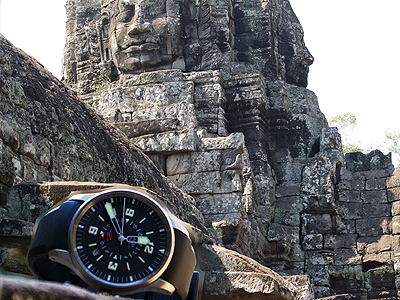
Angkor Thom,a walled and moated royal city, was the last capital of the Angkorian empire. After King Jayavarman VII recaptured the capital from invaders, he began a massive building campaign across the empire, constructing Angkor Thom as his new capital city. He began with existing structures and built a grand enclosed city around them, adding the outer wall and moat and some of Angkor's greatest temples, including his state temple, Bayon, set at the center of the city. Standing in the exact center of the walled city, Bayon Temple is thought to represent the intersection of heaven and earth. Bayon is known for its huge stone faces of the bodhisattva , with one facing outward and keeping watch at each compass point. The curious smiling image, thought by many to be a portrait of Jayavarman himself, has been dubbed by some the "Mona Lisa of Southeast Asia." There are 51 smaller towers surrounding Bayon, each with four faces of its own.
Cambodia has two distinct seasons -- the wet and the dry. Cambodia's wet season comes courtesy of the southwest monsoons, bringing with it frequent rains, heat and high humidity. In the peak of wet season, from July to September, it can rain as much as two out of every three days. The dry season runs from October to April, when the northeast monsoon arrives. Characterized by heat and dust, the temperatures become scorching and so dry it can take your breath away.

The extreme weather conditions allow Romain to put RGM’s rugged North Pointer to the test. The durable yet lightweight rubber strap is able to withstand the heat and humidity; the curved underside shape helps the wearer remain comfortable no matter what the temperature. Despite many years of war, Cambodia, as home of the Khmer culture, remains one of the most important and exotic countries in Southeast Asia. When we see Romain again he will be .............crossing the border into Thailand. Its Tiger feeding time with the Monks of Bangkok !




























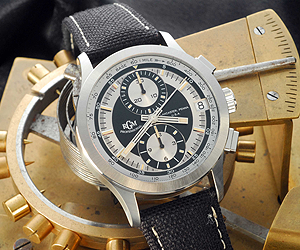


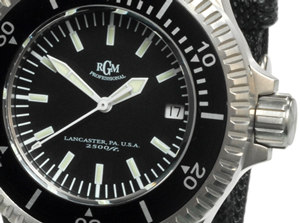


 Here at RGM we are continuing to uphold the finest traditions of American horology by introducing the Pennsylvania Tourbillon, our new flagship mechanical movement made here in Lancaster County Pennsylvania. The new Pennsylvania Tourbillon is signified by the state’s symbol, a keystone, surrounding a capital T, which will adorn watches in the first serially produced American Tourbillon watches ever made. Following on the heels of America’s first high grade mechanical movement in four decades, our RGM Caliber 801, the Pennsylvania Tourbillon represents significant advances in domestic watchmaking. The watch is not only made in the U.S.A., but is created and built in Lancaster County, Pennsylvania – one of the few traditional watchmaking centers of American watchmaking since the 1800s.
 The new model will be produced in a small numbered series, both as a standard model and for custom orders. Housed in a 43 mm x 12 mm case of either steelor 18k gold, the movement is a symphony of layers, showcasing many of the great elements of traditional watchmaking typical of RGM. Finely polished components share space with brushed elements and perlage. Wheel cocks borrow their shape from the RGM 801 and from classic American movements of yesteryear. The spokes of the wheels continue this theme. A 7-tooth click and winding wheels with wolf’s teeth are immersed in plates with subtle striped damaskeening. The movement is made of the finest quality traditional watchmaking materials such as German Silver, Gold, Silver, and Black Polished Steel.> All of these elements are juxtaposed among that which may be the most surprising of all: the label U.S.A. Never before has an American watchmaker introduced a series of Tourbillon wristwatches based upon a proprietary caliber. To do so, and to create them domestically, is an historic accomplishment.
 Additional remarkable features of this watch include hand-applied decoration such as guilloché (done on our antique rose engines), an inset hour and minute dial whose placement nicely balances the exposed Tourbillon, and a small curved sapphire window on the side of the case to allow a third view of the miniature ‘whirlwind’, the Pennsylvania Tourbillon’s cage, which is this model’s namesake.